Wednesday, April 11, 2012

Obama's Election Gameplan: I'm Barack, He's Barry


Rick Santorum went from being an annoyance to an afterthought in a matter of hours yesterday, but Mitt Romney, the GOP's newly anointed standard bearer, had no time at all to savor the culmination of his four-year campaign for the Republican nomination. Because down in Florida, President Obama launched a general-election broadside against the GOP that revealed in stark outlines what his emerging strategy will be. And Romney had better start rebutting it fast. 
Based on his three speeches yesterday as well as others he has recently made--particularly the one last week before the American Society of News Editors--Obama's strategy seems to be this: I'm going to persuade the American people to think that you, Gov. Romney, are the reincarnation of Barry Goldwater, an extremist extraordinaire both on the economy and foreign policy. One who lost in the biggest landslide in American history in 1964.
The president, campaigning in the critical swing state, delivered three speeches that sounded some common themes. The main one was that Romney and today's Republican Party have reverted back to the unreconstructed movement conservatism of Goldwater, one in which nothing much else matters but protecting the rich and shrinking government to a size not seen since the Eisenhower era.
Obama tossed back in Romney's face the line that the former Massachusetts governor has been taking during the primary campaign in order to fight the charge--made most effectively by Santorum--that he and the president are too similar: that this is a historic election between candidates with two fundamentally different concepts of government. "There are contrasting visions here," Obama said at one fundraiser event. "And this election will probably have the biggest contrast that we've seen maybe since the Johnson-Goldwater election -- maybe before that." 
Will Obama's tack work? Not necessarily. As my colleague Josh Kraushaar points out today, the country is much more center-right today than it was in the Goldwater era.
Yet the president wants to paint Romney not as the center-right governor he once was but rather as an ideological captive of the tea party. To drive home the point, Obama again resorted to a meme that has already become familiar: he invoked other GOP presidents going all the way back to Lincoln in arguing that today's Republicans are ideological extremists caught up in failed ideas.  Pushing for social equity and investing in the nation's future "is not historically a Democratic or Republican idea," Obama said at another event in Hollywood.  "It was Republican Teddy Roosevelt who called for a progressive income tax.  Dwight Eisenhower, Republican, built the Interstate Highway System.  It was, with the help of Republicans in Congress, FDR who gave millions of returning heroes, including my grandfather, a chance to get ahead through the GI Bill.  Abraham Lincoln, first Republican President, helped to bind this country together through the Transcontinental Railroad, started the land-grant colleges, National Academy of Sciences.  This is not just a Democratic idea." 
The president sounded this same theme, one we hear from him often, in a rousing speech at Florida Atlantic University. "We can't build a highway for ourselves," he said. "We got to get our neighbors and our friends to say let's go build a road.  That's why we supported the research and the technology that saved lives and created entire industries.  The Internet, GPS -- all those things were created by us together, not by ourselves."
Obama, in pushing for the populist Buffett rule requiring fair tax payments by millionaires, also sought to exploit perhaps the biggest sleeping-serpent issue of the election: the vast and growing income disparity in the country, which is at historic proportions.  
According to a recent report by the Congressional Budget Office, from 1979 to 2007, the nation's top 1 percent of earners saw their income quadruple 275 percent to $347,000. By contrast, the 60 percent of Americans considered middle-income earners experienced an increase of less than 40 percent. Indeed, the greatest beneficiaries of globalization and the Information Age, including an amply bailed-out Wall Street, are the richest "1 percent" of the nation, to adopt the language of the growing Occupy Wall Street movement. This fortunate elite increasingly prospers in a place apart, both physically and spiritually. 
Obama wants to cede the "1 percent" to Romney in this election, while he, the president, will be happy to take most of the rest. "There's a debate going on in this country right now:  Could we succeed as a nation where a shrinking number of people are doing really, really well, but a growing number are struggling to get by?" Obama told the crowd at FAU. "No!" they roared back.  
Remember that "etch-a-sketch" pivot to the middle we heard Romney was going to make? He'd better make it. Soon.

Monday, April 9, 2012

Gene Sperling Connects the Dots


I have often lamented the lack of new economic thinking in Washington, thanks to political gridlock and ideological paralysis. And I have criticized Barack Obama on a regular basis for his unwillingness to bring these new thinkers into his administration. Instead the president has spent a lot of time lamenting that, as I reported in December 2010, Reaganite free-market absolutism still rules Washington. As one prominent economist invited to the White House back then said of a private meeting with Obama, the president complained that "it was hard to change the narrative."  


So it's a pleasant surprise to hear some bold new thinking coming from a non-economist, Gene Sperling, who happens to be head of Obama's National Economic Council. In a little noticed speech calling for a "renaissance" of American manufacturing on March 27--highlighted today by Ezra Klein--Sperling got to the heart of the matter: it's time to stop pretending that we can endure without industrial policy of any kind in a world in which the U.S. is no longer automatically the most dominant economy. And yet because our policy-makers continue to pretend that markets will simply take care of themselves, this administration and others have had to do industrial policy on the sly, Jared Bernstein, Vice President Biden's former chief economist, told me for an article I did last fall called "The Left Behinds." "It’s all under an ad hoc hush-hush regime that ends up favoring the groups with the best lobbyists,” Bernstein said. Ad hoc, as in the last-minute bailout of the Detroit automakers or the eleventh-hour rescue of Wall Street in 2008. 

The problem with ignoring the need for industrial policy--or dismissing it as just more "Big Government picking winners"-- is NOT just that we are gradually losing U.S. manufacturing, which now makes up only 12 percent of the economy. What is so dangerous to America's  future is the loss of manufacturing COMBINED with the reduction of the U.S. market into just another player in a world economy with many new competitors. Why? Because that means that we are at risk of losing, perhaps forever, our best edge in the global economy: innovation. Multinational companies tend to move their R&D to the biggest consumer markets; it is no accident that, according to McKinsey Global Institute, China now leads us in patents and is graduating more engineers and scientists than us. This is happening in large part because China has become such a huge consumer market that U.S. multinationals are flocking to it, and China is reaping the benefits not just in job growth or wealth but more importantly in the innovation game, which will largely determine its future as a global power. We are losing the "virtuous cycle," for example what happened with IT in the '80s and '90s when both most of the consumption and the innovation was occurring here. 

This is what Sperling focused on in his speech. Citing work by Harvard Business School professors Gary Pisano and Willy Shih in 2009, Sperling warned that the "the virtuous cycle can become a vicious cycle, where following the loss of manufacturing capacity, the unique process engineering expertise cannot be maintained and our innovative capacity is drained."

Sperling, who since his days as Bill Clinton's NEC head has been a master at trying to find common ground on economic policy, tended to blunt his message a bit by arguing that the U.S. was an attractive place to invest for multinationals anyway. He's right; it is. But he only gave critics fodder with which to say simplistically, yet again, the market will take care of things, and that Obama's plan for infrastructure investments and manufacturing tax credits isn't needed. The future crisis is such that he needs to make his case "clearer than truth," as Dean Acheson once did in making the case for the Truman Doctrine against the Soviets. 

Still, at least we are hearing some new economic thinking in town. Hopefully we will hear a lot more. 
  

Friday, April 6, 2012

Why Wall Street Hasn't Changed--Part III (Return of the CDS Monster)


Bloomberg posted a story today that helps to explain why, as we wrote last week, big Wall Street banks like JPMorgan are desperate to slip in a couple of "technical amendments" to Dodd-Frank that could lay the groundwork for another financial catastrophe.
The lead of the story says it all: "A JPMorgan Chase & Co. trader of derivatives linked to the financial health of corporations has amassed positions so large that he’s driving price moves in the $10 trillion market, traders outside the firm said."
This is why is it is so very hard to be sympathetic to the lordly Jamie Dimon, the head of JPMorgan, as he constantly whines about an overbearing Washington, and so hard to be anything less than angry at the Obama Treasury Department and others as they look the other way while Dodd-Frank, flawed as it is, is quietly undermined and evaded.
The trader featured in the Bloomberg story, Bruno Iksil, works out of London. No surprise, as we wrote in "Why Wall Street Hasn't Changed--Part II," the big banks are pushing hard to water down the Volcker Rule, which would prevent them taking risks with taxpayer-supplied federal guarantee money by banning large-scale proprietary trading. No surprise they are also fighting for passage of H.R. 3283, a bill that would allow them to evade capital and margin requirements by exempting their foreign affiliates--like the J.P. Morgan outfit in London. So, if it becomes law, a foreign affiliate could cut a swap or derivatives deal with a foreign affiliate of a U.S. corporation  with no one watching and no capital posted, just as if 2008 never happened. 
As the Bloomberg story notes, Dimon continues to bleat about these restraints, complaining that regulators "have proposed regulations of mind-numbing complexity.” In his annual letter to shareholders released this week, Dimon added hopefully that “even senior regulators now recognize that the current proposed rules are unworkable and will be impossible to implement.”
Welcome back to the year 2007, folks. Do we really want to go there?

Wednesday, April 4, 2012

Will Obama's Fall Campaign Follow the '96 Template?


No one would have thought of the comparison six months ago, before the economic data turned a bit more bright and Mitt Romney went a lot more Right. But based on President Obama’s feisty speech on Tuesday—now widely seen as the opening barrage of the fall campaign—the template for his reelection effort could well be Bill Clinton’s smashingly successful 1996 run against a hapless Bob Dole.
In that campaign, then-President Clinton sought early on to tie the center-right Kansas senator to the then-far-right Newt Gingrich, speaker of the House. In particular he warned voters that “Dole-Gingrich” would cost them large parts of their Social Security and Medicare. The charges stuck in a devastating way, helped by Dole’s decision to run with a zealous supply-sider, former Rep. Jack Kemp.
Now Obama is seeking to join Romney at the hip of another congressman, Rep. Paul Ryan, R-Wis., whose budget is so tea party-driven that a Congressional Budget Office study showed his planned cuts would effectively eliminate the entire U.S. government except for defense, Social Security, Medicare, children’s insurance, and interest payments. 
And the president made a point of going into minute detail about just how far right the axis has shifted since 1996. “Instead of moderating their views even slightly, the Republicans running Congress right now have doubled down, and proposed a budget so far to the right it makes the Contract With America look like the New Deal,” he said to laughter. “In fact, that renowned liberal, Newt Gingrich, first called the original version of the budget 'radical' and said it would contribute to 'right-wing social engineering.' "
Obama went on at length about how the Republicans of previous eras—including the formerly right-wing Gingrich—had been so much more reasonable. “It was Eisenhower who launched the interstate highway system and new investment in scientific research. It was Richard Nixon who created the Environmental Protection Agency, Ronald Reagan who worked with Democrats to save Social Security. It was George W. Bush who added prescription-drug coverage to Medicare,” the president said.
And then Obama moved in for the kill:
Ryan’s budget “is now the party's governing platform. This is what they're running on,” he said.  And “Governor Romney” –it was the first time Obama mentioned him by name – “has said that he hoped a similar version of this plan from last year would be introduced as a bill on day one of his presidency. He said that he's 'very supportive' of this new budget, and he even called it 'marvelous' -- which is a word you don't often hear when it comes to describing a budget."
There are, of course, more differences than similarities between the electoral environments of 1996 and 2012. The main one is that, despite a spate of good news on the economy, including the return of the stock market to levels not seen since before the 2008 crash, Obama must still run a campaign that ignores a lot of bad news. In particular he must reckon with an unemployment rate that is at 8.3 percent, and now has gone a record 36 months above 8 percent, and is likely to remain higher than it was at Obama's inauguration (7.8 percent) by Election Day. By comparison, Clinton could point to a booming economy—including one of the very few periods of income growth across the board—a shrinking deficit and unemployment at around 6 percent.
Romney, in his riposte on Wednesday to the same group of newspaper editors, reminded everyone of those facts and Obama’s tenure presiding over “the weakest recovery since the Great Depression.” But rather than directly parrying Obama, Romney railed against “arguments that no one is making,” and accused Obama of setting up “a straw man” to divert his record on the economy. And while Obama had the journalists laughing at his mordant wit, Romney’s laugh-o-meter didn’t register quite as high.

Tuesday, April 3, 2012

Martin, Barton and Romney


He never did give us a New Deal, but President Obama did don the persona of FDR in his speech today to the American Society of News Editors, presaging the political campaign to come. 

In remarks that seemed to have echoes of FDR's famous "Martin, Barton and Fish" address in 1940, Obama's opening line of attack was pure mockery. Obama said Paul Ryan's budget plan is so extreme that it makes "the Contract with America look like the New Deal." He lampooned Gingrich as "a renowned liberal" who himself called last year's Ryan plan "radical." And he poked fun at Romney for saying passage of the budget would be "marvelous, which isn't a word you hear often with respect to budgets." Comedic pause. "It's not even a word you hear all that often generally."

Hahahahaha. Actually the journalists WERE laughing pretty hard.

Obama's basic argument was that the GOP is run by right-wing lunatics, as evidenced by the Ryan budget, and Mitt Romney's now one of them. To which the president added for good measure: "It's laughable."

Game on.

The Long Show Is Over. The Long Slog Begins...


Andy Borowitz, characteristically, took the funniest shot at the GOP yesterday when he posted a faux news story in which the presidential candidates announced that the whole primary season had been an April Fool's Day prank. "I'm just amazed that the American people never figured out we were kidding," the "story" quoted Herman Cain as saying. "I mean, I kept saying '9-9-9' every four seconds, which was total and utter bullshit."


It did seem like a comedy act at times, or maybe more of a Bizarro circus, with Mitt Romney as the fumbling ringmaster who never knew which act was coming next; Rick Perry as the not-ready-for-center-ring trapeze artist who kept falling without a net; Newt as the clown who liked to have himself fired out of a cannon but kept overshooting; Michele Bachmann as the scary snake lady; and so on.


Now Rick Santorum, who tried so hard to be the elephant tamer but could never quite get the giant beast to lumber his way, is finishing the last act, and the circus is about to leave town.


What comes next is going to be a lot grimmer: a marathon of money- and mud-slinging between two men -- Romney and Obama -- who in truth are not all that different in outlook, intellect or temperament but who will try desperately to persuade all of us over the next eight months that they are.


Each candidate has a somewhat disaffected base to placate; each a somewhat exotic background; and each is a pragmatist at heart. Each of them will now, very pragmatically, turn his focus toward the Middle. Romney is about to start reminding voters that he can govern well--which means compromise--and is the Better Obama. Obama, despite his GOP-cast image as a liberal, will argue he's a much Better Romney. Recall that he has sought to placate business and left Wall Street largely intact, and he is taking a far tougher line on foreign policy--one that reflects a traditional GOP "realpolitik" view and a dramatic ratcheting up of covert war-- than is generally acknowledged, even when it comes to China. 


The fun part is over.


Friday, March 30, 2012

Why Wall Street Hasn't Changed--Part II


While you weren't watching -- maybe you were trying to figure out what in heck the Supreme Court's been talking about on health care -- the Wall Street lobby has been up to its old games in the House of Representatives over an issue that's even harder to comprehend than an oral argument on the Commerce Clause. With bipartisan support, the big banks are sneaking through a couple of "technical amendments" to Dodd-Frank that seem hopelessly arcane but in fact could lay the groundwork for another financial catastrophe.


 In case you're still reading, one bill is H.R. 3283, or the "Swap Jurisdiction Certainty Act." Like the name? CERTAINTY ACT. Sounds impressive, huh. Actually it's totally Orwellian, along the lines of "War Is Peace," "Freedom Is Slavery," etc. What this baby does is to create enough UNcertainty in Dodd-Frank to allow U.S. banks to evade capital and margin requirements by exempting their foreign affiliates. So, if it becomes law, a foreign affiliate of Goldman could cut a swap or derivatives deal with a foreign affiliate of GM with no one watching and no capital posted, just as if 2008 never happened. And because banks are totally global, switching the lion's share of their swap dealing abroad would be as easy as pushing a button.


To quote Michael Greenberger, a former top federal regulator and a law professor and derivatives expert at the University of Maryland: "This is being explained as a technical amendment. That’s a nice way of describing a loophole that a stealth bomber could go through."


The scariest thing about it is that if it becomes law, global swap dealers would evade derivatives regulation but the "U.S. economy could not evade the fallout," as Americans for Financial Reform, a group calling for tougher regulation, writes in a protest letter to the House. As we saw with Lehman and AIG during the crash, U.S. parents can implode based on what some unit in London is up to; recall that something similar happened to Barings after 230 years of operation because of a rogue derivatives trader in Singapore.


The other companion bill is called the end user margin exemption amendment, which passed the House this week with massive bipartisan support, 370-24. It bars regulators from requiring so-called end-users to post margin on swaps trades. This would allow investment banks to escape capital margin requirements they agreed to when they became bank holding companies in order to get all that bailout money and save their skins in 2008.


What it all amounts to is an intense, behind-the-scenes lobbying campaign that the banks have been pursuing since the early days of Dodd-Frank. Even after we learned  that not a single Wall Street CEO understood what his traders were doing before September 2008, the global banks still want to keep derivatives trading in the dark and out of regulatory control as much as possible. Back in December 2009, I wrote a story for Newsweek citing a secret lobbying effort by banks to channel their demands through famous corporate "end-users" like GM, Apple and Whirlpool--to whom Congress would be more sympathetic. "This is an orchestrated, well-funded effort by the banks to manipulate our legislation and leave no fingerprints," a congressional staffer involved in drafting Dodd-Frank told me then. The staffer passed on to me nine pages of proposed changes in the legislation intended to protect trading from open scrutiny—all of it on paper without a letterhead—that she said came from Goldman Sachs. 


The campaign tried to make the case that curbs on derivatives don't hurt just Wall Street but also the corporations in Main Street America—the "end users" —that need them to hedge risks. Airlines, for example, use derivatives as protection against sudden gyrations in fuel costs by "swapping" interest-rate payments or currencies with other companies. But when Wall Steet privately negotiates these deals off exchanges, it is harder for investors—and regulators—to assess the fair value and real risk of the deals. This makes it easier for the banks to charge a large "spread" and earn big profits. "It's like the used-car market, except that it's even less transparent," Adam White, a derivatives expert at White Knight Research in Atlanta, told me then.


And the arguments made by the lobbyists, as well as by lawmakers and the U.S. Treasury, haven't changed since the '90s: we MUST have  these exemptions to be globally competitive. It's precisely what we heard more than a decade ago, when they brought down Glass-Steagall and enacted the Commodity Futures Modernization Act. As then-Treasury Secretary Larry Summers noted, the latter law was necessary to “allow the United States to maintain its competitive position in this rapidly growing sector.”
If fact, that 2000 law marked a decisive point in the forthcoming subprime mortgage crisis, according to the majority report of the Financial Crisis Inquiry Commission in late 2010.  From then until mid-2008, for seven and a half years, the over-the-counter derivatives market grew more than sevenfold, without transparency, without any state or federal regulator knowing really what was going on in the market, without any controls on growing counterparty credit risk. It effectively interconnected all the financial institutions in this country and around the world. It also opened the door to credit default swaps, the rampant development of which fueled securitization and amplified  the problems.


Unless someone starts paying serious attention to this legislation, this is the world we're heading back into....

Wednesday, March 28, 2012

How Romney is turning himself into Goldwater '64


Mitt Romney is delivering up so much delicious red campaign meat to Obamaland these days that I had to wonder whether they're already making plans for the re-election dinner party in Chicago. So I called a friend who is working for the president's re-election, and this person joyfully confirmed: yes, ol' Mitt is the gift that keeps on giving.

If Romney keeps giving like this, he may give the Obama campaign more than enough fodder to take out his candidacy on foreign policy alone. Most recently I wondered whether the Obama team would turn him into Michael Dukakis on the basis of his aide's Etch A Sketch gaffe. Now I wonder whether the better play isn't to cast Romney as Barry "Extremism in the defense of liberty is no vice" Goldwater, whose trouncing by LBJ in 1964 had a lot to do with public fears that he was a warmonger.

I had already written about Romney's lurch rightward on foreign policy. Previously he has virtually threatened war with Iran and the perpetuation of war in Afghanistan. But Romney's remarks to CNN about Russia, calling Moscow "without question our number one geopolitical foe" and saying that the Russians "fight every cause for the world's worst actors," seemed to mark a new level of indiscretion for the hyperventilating former Massachusetts governor.

Set aside the merits of the comment. Yes, Obama did give Romney an opening when, mistakenly speaking through an open mike, the president suggested to his counterpart, Dimitri Medvedev, that he'd have more "flexibility" to negotiate missile defense and other issues after his re-election. And yes, the Russians are acting pretty aggressively these days; the re-election of the revanchist Vladimir Putin virtually ensures the tensions will continue. We also know that Romney is desperately tossing bouquets of toxic word-flowers at his rightwing base, trying to make up in aggressiveness what he lacks in conservative credentials.

But is it really smart politics for the all-but-certain GOP nominee to be appearing as a warmonger to a war-weary America? And at a time when Russia and the U.S. are already involved in something of a proxy war in Syria, as my colleague Jim Kitfield wrote this week? Certainly the Obama team doesn't think so, and they are gathering up every TV and Youtube clip of Romney's Goldwateresque statements right now.

They'll have their own word bouquet to deliver to the American public in the general election campaign.

Monday, March 26, 2012

Larry Summers, Master Evader


Nowhere is is the art of avoiding responsibility for one's actions so highly developed as in Washington, D.C. And in my 15 years of covering the nation's capital, I have seen no more masterful practitioner of this art than Larry Summers, Barack Obama's former chief economic advisor.

Exhibit A--actually it's more like Exhibit 942 -- is Dr. Summers' op-ed in The Washington Post on Monday. He begins, in Summers-like fashion, with a pre-emptive strike on all the critics who are saying that he failed the president with bad advice and bad policy. Summers writes: "Economic forecasters divide into two groups: those who cannot know the future but think they can, and those who recognize their inability to know the future." In other words, it is utterly impossible to know what will happen to the economy in the future, so anyone who presumes to guess at it is an idiot. The smart ones, like me, won't even try.


This is Summers' way of absolving himself for his serious misjudgments over the last three years under Obama--his failure to appreciate the dimensions of the economic crisis, to push for a large enough stimulus and a deep enough housing fix--and perhaps as well for the titanic errors he made in his previous incarnation as Bill Clinton's Treasury secretary, when he oversaw financial deregulation that set the stage for the worst collapse since the Great Depression.


We simply couldn't know what was going to happen, Summers is saying. Furthermore, "such recovery as we are enjoying is less a reflection of the natural resilience of the American economy than of the extraordinary steps that both fiscal and monetary  policymakers" -- guys like me, that is-- have taken. So I'm good, yo. Summers then draws tightly around him the Olympian robes of a Harvard academic, urging Washington's benighted policymakers not to withdraw the economic medicine he so sagely administered. 


Let's yank off those robes and reveal the hypocrite beneath. The one who dominated policy-making in Washington for some 10 years even though his actions often violated the spirit and conclusions of his own considerable body of academic work. As has been the case throughout his career, Summers was surrounded by high-level naysayers who urged him to take more dramatic action, who DID sense that the economy needed deeper fixes. He dismissed them at the time as stupider than him, and then later on pretended their advice didn't exist, as part of the cover-up. 


Take housing; the underwater mortgage market is still the biggest drag on a still-deleveraging economy; yet the same administration that shoveled hundreds of billions to the Wall Streeters who had fraudulently sold all those mortgage-backed securities has had little sympathy for the mortgage holders who got shafted.  My National Journal colleagues Stacy Kaper and Kristin Roberts, in an exhaustive account of just how timid and inadequate the administration's housing solutions were, write that Summers and Treasury Secretary Tim Geithner avoided what was desperately needed: a "cramdown," which would have allowed federal bankruptcy judges to force banks to reduce mortgage balances, cut interest rates, and lengthen the terms of loans to help borrowers get out of trouble. Even Obama's own housing secretary, Shaun Donovan, called it a "missed opportunity." But "Summers and Geithner didn’t try, according to numerous sources who were involved in the discussions," Kaper and Roberts write. "Instead, they sided and with the financial sector, and the administration went quiet as Wall Street pulled out all the stops to kill cramdown in the Senate." 


Then there was the stimulus. As Noam Scheiber records in his new book, because of Summers' underhanded efforts to mute Christina Romer, the chairwoman of the Council of Economic Advisors, in the early debate, Obama was given the option of only a modestly sized stimulus and had "little reason to suspect that this amount was perhaps $1 trillion too small.” And Romer was hardly the only economist who dared to peer into the future and pronounce the stimulus inadequate; among those who did at the time were Joseph Stiglitz and Paul Krugman. Even Harvard's Ken Rogoff was saying well before the 2008 election just how bad things were going to get. And this was a guy who advised John McCain! 


Nor has Summers ever owned up to his responsibility for deregulation in the 1990s.  In an extraordinary TV interview in January, which Felix Salmon of Reuters and others have written about, Summers maintained precisely the same line he had previously taken with me and others: he couldn't see far enough over the horizon. The future was utterly unknowable. Summers said that when he sponsored the Commodity Futures Modernization Act in 2000 -- creating essentially a global laissez faire market in derivatives--credit default swaps hadn't even been invented yet. How could I have known what was to come? "If you want to assign responsibility, If you take a market that essentially didn’t exist in the 1990s, that grew for eight years from 2001 to 2008, and then brought on a major collapse, if you were looking to hold people responsible, you would look to… officials of the Bush Administration," he said.


In fact credit derivatives did exist, as Salmon writes, and 
plenty of people were worried about them. In post-2008 interviews with me and others, Summers sought to recast himself as a pro-regulation man. But in 1998 Summers  called then chairwoman of the Commodity Futures Trading Commission, Brooksley Born, and loudly ordered her to desist from a proposal for regulating "over the counter" derivatives. Born was eventually railroaded out of her job, and others, like Arthur Levitt, the chairman of the Securities and Exchange Commission during the Clinton years, felt badly about it. Levitt too had gone alone with the pillorying of Brooksley Born, but after the crash ten years later he told me: "All tragedies in life are always proceeded by warnings. We had a warning. It was Brooksley Born. We didn't listen to that." Levitt  told other reporters they had made a mistake by quashing Born's ideas.

When Summers heard about such comments, he got upset with Levitt. Shortly after the November 2008 election, when Summers and Levitt were called into a meeting on the crisis with House Speaker Nancy Pelosi, the two of them were walking out of the conference room together when Summers quietly told him, "I read somewhere you were saying that maybe Brooksley Born was right. ... But you know she was really wrong," he said, according to someone who overheard the conversation, which Levitt later confirmed. "Her plan was no good. And we offered a different plan." In truth there had been no other plan, at least not one that anyone ever tried to enact.

In Summers' solipsistic view of the world, he was on the right side, every time. But in the real world, the overwhelming body of evidence is against him. Every time.

Read More http://www.gq.com/blogs/the-q/2010/09/dont-let-the-door-hit-ya-larry-summers-an-excerpt-from-capital-offense-how-washingtons-wise-men-turn.html#ixzz1qG9Jglje
 

Friday, March 23, 2012

How Romney Could Become Dukakis


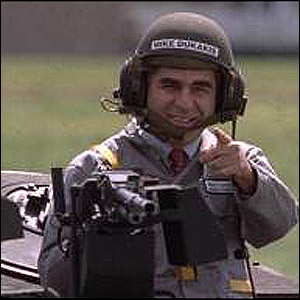
Sometimes they never recover. Even now, to the extent anyone remembers it at all, the 1988 presidential campaign lives on in memory in one indelible image: that of Michael Dukakis bouncing around in a tank, an oversized helmet on his head and a goofy grin on his face, as if even he knew that, at that moment, he'd just blown his chances to get to the White House. Dan Quayle never recovered from his public misspelling of "potato," just as Sarah Palin will never recover from Tina Fey's lacerating parody of her in 2008 and Julianne Moore's nail-in-the-coffin portrayal in "Game Change."

It's one of the unwritten corollaries to presidential politics: if you become a joke, people won't vote for you.

It would be a cruel irony indeed for Mitt Romney, whose father's political career was ended with one indelible word--"brainwashed"--if the son suffered the same fate at the hands of one of his most loyal aides, Eric Fehrnstrom. But if the Obama campaign were smart, right now it would be using some of its millions of dollars to hire the best former "Saturday Night Live" writers out there, all in an effort to keep the country laughing at the image of Mitt Romney as "the Etch A Sketch candidate."

That might mean taking a page from George H.W. Bush's campaign. The late Lee Atwater, in some ways the founder of modern attack politics, helped to turn what was intended to be an ad that bolstered Dukakis's weak image on defense into devastating and defining imagery.

Similarly, the Etch A Sketch image is almost certain to linger on--helped by the giddy pouncing of Rick Santorum and Newt Gingrich--because it amounted to a bull's eye on Romney's central vulnerability. The Obama team had already been calling him a man without a "core," but now the internet is filled with images of Romney's face about to be erased on the iconic children's toy. Much as Michael Dukakis handed George H.W. Bush--who was losing in the polls at the time-- a priceless gift, the Romney campaign seems to have done the same for Obama.