Wednesday, March 28, 2012

How Romney is turning himself into Goldwater '64


Mitt Romney is delivering up so much delicious red campaign meat to Obamaland these days that I had to wonder whether they're already making plans for the re-election dinner party in Chicago. So I called a friend who is working for the president's re-election, and this person joyfully confirmed: yes, ol' Mitt is the gift that keeps on giving.

If Romney keeps giving like this, he may give the Obama campaign more than enough fodder to take out his candidacy on foreign policy alone. Most recently I wondered whether the Obama team would turn him into Michael Dukakis on the basis of his aide's Etch A Sketch gaffe. Now I wonder whether the better play isn't to cast Romney as Barry "Extremism in the defense of liberty is no vice" Goldwater, whose trouncing by LBJ in 1964 had a lot to do with public fears that he was a warmonger.

I had already written about Romney's lurch rightward on foreign policy. Previously he has virtually threatened war with Iran and the perpetuation of war in Afghanistan. But Romney's remarks to CNN about Russia, calling Moscow "without question our number one geopolitical foe" and saying that the Russians "fight every cause for the world's worst actors," seemed to mark a new level of indiscretion for the hyperventilating former Massachusetts governor.

Set aside the merits of the comment. Yes, Obama did give Romney an opening when, mistakenly speaking through an open mike, the president suggested to his counterpart, Dimitri Medvedev, that he'd have more "flexibility" to negotiate missile defense and other issues after his re-election. And yes, the Russians are acting pretty aggressively these days; the re-election of the revanchist Vladimir Putin virtually ensures the tensions will continue. We also know that Romney is desperately tossing bouquets of toxic word-flowers at his rightwing base, trying to make up in aggressiveness what he lacks in conservative credentials.

But is it really smart politics for the all-but-certain GOP nominee to be appearing as a warmonger to a war-weary America? And at a time when Russia and the U.S. are already involved in something of a proxy war in Syria, as my colleague Jim Kitfield wrote this week? Certainly the Obama team doesn't think so, and they are gathering up every TV and Youtube clip of Romney's Goldwateresque statements right now.

They'll have their own word bouquet to deliver to the American public in the general election campaign.

Monday, March 26, 2012

Larry Summers, Master Evader


Nowhere is is the art of avoiding responsibility for one's actions so highly developed as in Washington, D.C. And in my 15 years of covering the nation's capital, I have seen no more masterful practitioner of this art than Larry Summers, Barack Obama's former chief economic advisor.

Exhibit A--actually it's more like Exhibit 942 -- is Dr. Summers' op-ed in The Washington Post on Monday. He begins, in Summers-like fashion, with a pre-emptive strike on all the critics who are saying that he failed the president with bad advice and bad policy. Summers writes: "Economic forecasters divide into two groups: those who cannot know the future but think they can, and those who recognize their inability to know the future." In other words, it is utterly impossible to know what will happen to the economy in the future, so anyone who presumes to guess at it is an idiot. The smart ones, like me, won't even try.


This is Summers' way of absolving himself for his serious misjudgments over the last three years under Obama--his failure to appreciate the dimensions of the economic crisis, to push for a large enough stimulus and a deep enough housing fix--and perhaps as well for the titanic errors he made in his previous incarnation as Bill Clinton's Treasury secretary, when he oversaw financial deregulation that set the stage for the worst collapse since the Great Depression.


We simply couldn't know what was going to happen, Summers is saying. Furthermore, "such recovery as we are enjoying is less a reflection of the natural resilience of the American economy than of the extraordinary steps that both fiscal and monetary  policymakers" -- guys like me, that is-- have taken. So I'm good, yo. Summers then draws tightly around him the Olympian robes of a Harvard academic, urging Washington's benighted policymakers not to withdraw the economic medicine he so sagely administered. 


Let's yank off those robes and reveal the hypocrite beneath. The one who dominated policy-making in Washington for some 10 years even though his actions often violated the spirit and conclusions of his own considerable body of academic work. As has been the case throughout his career, Summers was surrounded by high-level naysayers who urged him to take more dramatic action, who DID sense that the economy needed deeper fixes. He dismissed them at the time as stupider than him, and then later on pretended their advice didn't exist, as part of the cover-up. 


Take housing; the underwater mortgage market is still the biggest drag on a still-deleveraging economy; yet the same administration that shoveled hundreds of billions to the Wall Streeters who had fraudulently sold all those mortgage-backed securities has had little sympathy for the mortgage holders who got shafted.  My National Journal colleagues Stacy Kaper and Kristin Roberts, in an exhaustive account of just how timid and inadequate the administration's housing solutions were, write that Summers and Treasury Secretary Tim Geithner avoided what was desperately needed: a "cramdown," which would have allowed federal bankruptcy judges to force banks to reduce mortgage balances, cut interest rates, and lengthen the terms of loans to help borrowers get out of trouble. Even Obama's own housing secretary, Shaun Donovan, called it a "missed opportunity." But "Summers and Geithner didn’t try, according to numerous sources who were involved in the discussions," Kaper and Roberts write. "Instead, they sided and with the financial sector, and the administration went quiet as Wall Street pulled out all the stops to kill cramdown in the Senate." 


Then there was the stimulus. As Noam Scheiber records in his new book, because of Summers' underhanded efforts to mute Christina Romer, the chairwoman of the Council of Economic Advisors, in the early debate, Obama was given the option of only a modestly sized stimulus and had "little reason to suspect that this amount was perhaps $1 trillion too small.” And Romer was hardly the only economist who dared to peer into the future and pronounce the stimulus inadequate; among those who did at the time were Joseph Stiglitz and Paul Krugman. Even Harvard's Ken Rogoff was saying well before the 2008 election just how bad things were going to get. And this was a guy who advised John McCain! 


Nor has Summers ever owned up to his responsibility for deregulation in the 1990s.  In an extraordinary TV interview in January, which Felix Salmon of Reuters and others have written about, Summers maintained precisely the same line he had previously taken with me and others: he couldn't see far enough over the horizon. The future was utterly unknowable. Summers said that when he sponsored the Commodity Futures Modernization Act in 2000 -- creating essentially a global laissez faire market in derivatives--credit default swaps hadn't even been invented yet. How could I have known what was to come? "If you want to assign responsibility, If you take a market that essentially didn’t exist in the 1990s, that grew for eight years from 2001 to 2008, and then brought on a major collapse, if you were looking to hold people responsible, you would look to… officials of the Bush Administration," he said.


In fact credit derivatives did exist, as Salmon writes, and 
plenty of people were worried about them. In post-2008 interviews with me and others, Summers sought to recast himself as a pro-regulation man. But in 1998 Summers  called then chairwoman of the Commodity Futures Trading Commission, Brooksley Born, and loudly ordered her to desist from a proposal for regulating "over the counter" derivatives. Born was eventually railroaded out of her job, and others, like Arthur Levitt, the chairman of the Securities and Exchange Commission during the Clinton years, felt badly about it. Levitt too had gone alone with the pillorying of Brooksley Born, but after the crash ten years later he told me: "All tragedies in life are always proceeded by warnings. We had a warning. It was Brooksley Born. We didn't listen to that." Levitt  told other reporters they had made a mistake by quashing Born's ideas.

When Summers heard about such comments, he got upset with Levitt. Shortly after the November 2008 election, when Summers and Levitt were called into a meeting on the crisis with House Speaker Nancy Pelosi, the two of them were walking out of the conference room together when Summers quietly told him, "I read somewhere you were saying that maybe Brooksley Born was right. ... But you know she was really wrong," he said, according to someone who overheard the conversation, which Levitt later confirmed. "Her plan was no good. And we offered a different plan." In truth there had been no other plan, at least not one that anyone ever tried to enact.

In Summers' solipsistic view of the world, he was on the right side, every time. But in the real world, the overwhelming body of evidence is against him. Every time.

Read More http://www.gq.com/blogs/the-q/2010/09/dont-let-the-door-hit-ya-larry-summers-an-excerpt-from-capital-offense-how-washingtons-wise-men-turn.html#ixzz1qG9Jglje
 

Friday, March 23, 2012

How Romney Could Become Dukakis


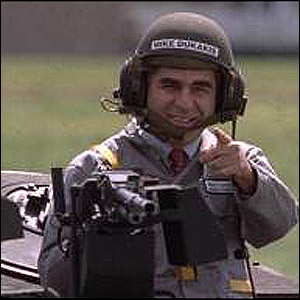
Sometimes they never recover. Even now, to the extent anyone remembers it at all, the 1988 presidential campaign lives on in memory in one indelible image: that of Michael Dukakis bouncing around in a tank, an oversized helmet on his head and a goofy grin on his face, as if even he knew that, at that moment, he'd just blown his chances to get to the White House. Dan Quayle never recovered from his public misspelling of "potato," just as Sarah Palin will never recover from Tina Fey's lacerating parody of her in 2008 and Julianne Moore's nail-in-the-coffin portrayal in "Game Change."

It's one of the unwritten corollaries to presidential politics: if you become a joke, people won't vote for you.

It would be a cruel irony indeed for Mitt Romney, whose father's political career was ended with one indelible word--"brainwashed"--if the son suffered the same fate at the hands of one of his most loyal aides, Eric Fehrnstrom. But if the Obama campaign were smart, right now it would be using some of its millions of dollars to hire the best former "Saturday Night Live" writers out there, all in an effort to keep the country laughing at the image of Mitt Romney as "the Etch A Sketch candidate."

That might mean taking a page from George H.W. Bush's campaign. The late Lee Atwater, in some ways the founder of modern attack politics, helped to turn what was intended to be an ad that bolstered Dukakis's weak image on defense into devastating and defining imagery.

Similarly, the Etch A Sketch image is almost certain to linger on--helped by the giddy pouncing of Rick Santorum and Newt Gingrich--because it amounted to a bull's eye on Romney's central vulnerability. The Obama team had already been calling him a man without a "core," but now the internet is filled with images of Romney's face about to be erased on the iconic children's toy. Much as Michael Dukakis handed George H.W. Bush--who was losing in the polls at the time-- a priceless gift, the Romney campaign seems to have done the same for Obama.

Thursday, March 22, 2012

Romney Etches Out the Real History of the Wall Street Bailout


Answering critics who are gleefully calling him the the Etch A Sketch candidate, Mitt Romney stood fast on one of his long-held positions Wednesday, defending George W. Bush's financial bailout of Wall Street in 2008. That might be considered a rather gutsy stand, considering that Bush has been persona non grata among Republicans in this campaign, the conservative base despises the policy and Romney's chief rival for the presidential nomination, Rick Santorum, has condemned the bailout as unnecessary and "injurious to capitalism."

And what Romney said is at least partly true: almost every mainstream economist agrees that had there not been a bailout, the entire U.S. financial system would have collapsed and the nation would very likely be in the middle of a second Great Depression right now.

But in his remarks in Maryland, Romney also ignored--or etched out--much of the financial history that led to the bailout. "I keep hearing the president say that he's responsible for keeping America from going into a Great Depression," Romney said. "No, no, no. That was President George W. Bush and [then Treasury Secretary] Hank Paulson that stepped in and kept that from happening."

Umm, yeah, they did, but only after Paulson, as head of Goldman Sachs, lobbied to raise leverage limits that fueled Wall Street's untrammeled risk-taking machine and after Bush, for eight years, sponsored low-income housing and deregulatory policies that promoted the illusory idea of a self-stabilizing Wall Street, gutted the financial regulatory system and set the stage for the disaster.

It is little remembered today that President Bush was so completely flummoxed by the financial collapse that, according to his own former speechwriter, Matt Latimer, he didn't seem to comprehend at first what had happened, nor that the Treasury was planning to pay more for Wall Street's toxic securities than they were really worth in order to sustain the reckless banks. "Why did I sign on to this proposal if I don't understand what it does?" he told Latimer plaintively. Just before the crash, Bush had hoped to deliver a series of "legacy speeches" touting his accomplishments, including a robust economy. 

Romney, in his remarks, may have been just sketching out how he plans to run in the fall--as well as conveniently reminding voters of the story he hoped would dominate the news yesterday, that George W. Bush's prominent brother, Jeb, had just endorsed him. But that's no excuse for etching out the real story of what happened.

Picture credit: http://www.plunderbund.com/wp-content/uploads/2012/03/romney-etch-a-sketch.jpg

Tuesday, March 20, 2012

Why the Tea Party Is Still Winning


Remember the 2012 presidential campaign--that sort-of big event that we've all been obsessing about? Well, the Republican-led House of Representives, the epicenter for tea-party passions, doesn't seem very interested in who's going to be president at the moment. With the House set to engage in another vicious fight over today's new 2013 budget proposal by Rep. Paul Ryan, R-Wis., we are witnessing once again a phenomenon that's been apparent since the 2010 election: the tea party movement still holds the commanding heights of American politics. It is still setting the agenda for national debate. It wants what it wants. And it doesn't much care what anyone in either the GOP or Democratic Party thinks about it.

Consider: while the GOP presidential candidates are all keeping arms' length from the Ryan budget, knowing that its proposals for immediate deep cuts will be unpopular, conservatives in the House are attacking Ryan from the other side, frustrated that his $1.028 trillion spending plan is too meek and takes too many years to bring the budget into balance. The Washington Post quoted one "senior GOP strategist" as whining that the "House Republicans are still under the mistaken impression they have to lead. It's a presidential election year; they're along for the ride."

Sorry, pal, it's you who's along for the ride. And Mitt Romney. And Rick Santorum. And Newt Gingrich. They've all spent the campaign trying to prove their small-government bona fides, with limited success, to a radicalized base. Now it's about to get tougher for them to vouch for their authenticity: the Ryan budget they want to avoid, just rolled out today, virtually ensures that the budget standoff will continue through November. In this debate, the presidential campaign will be just so much noise.

A kind of parallel political universe exists in the country today, completely separate from the presidential campaign.  In an article last summer about the debt-ceiling fight, I questioned whether the tea-party revolt that brought America to the brink of first-ever default was simply a bunch of Dog Day Afternoon crazies holding the country hostage, or were these people more John Brown-kind-of-crazy? Was the standoff, in other words, a kind of economic Harpers Ferry--the first shots fired in a righteous war over the size of government? Were we witnessing the outbreak of a civil war over opposing fundamental views of Washington?

I think the answer is clearer now. Fault them if you will as a band of primitivist monomaniacs, question whether they're sincere enough to give up their own Social Security and Medicaid along with everyone else's, but the tea partiers are not going to fade away. They clearly represent a deep and abiding -- and perhaps last-ditch-- movement of resistance to the indomitable tendency of American government to grow ever larger. They know that the various eruptions of conservative rebellion since the Reagan era, including the Gingrich-led takeover of the House in 1994, each amounted to little more than one step forward, two steps back. They know that George W. Bush blew the budget out entirely. And they know that none of the GOP candidates, "establishment" or not, is delivering up the answer they want. Except maybe for Ron Paul, which accounts for his rise from the fringes.

Mancur Olson, the late, great University of Maryland economist, theorized that the demands of ever-multiplying special interests in Washington will win out over those who fight for the "common good." These interests pile up over time and cause a kind of sclerosis in the system. That's why government spending and programs tend to accumulate rather than decrease.

The tea party conservatives seem to have divined this tendency, whether they've read Mancur Olson or not (likely not), and they want to stand athwart it and yell, "Stop." While Romney talks in general terms about how his business acumen is what's needed to slash government, and Santorum about how this campaign is really about "being a fighter for freedom," and Newt harks back to his split-second of glory in '94-95, the fed-up American conservatives who loosely make up the tea party are still looking for a real champion. But more, they believe they are pursuing a real cause.

Bet on it. Like them or not, they're not going away, no matter who wins in November.

Thursday, March 15, 2012

Has Wall Street Really Changed? (Guess what I think)


OK, so who do we believe? In a cover story in New York magazine last month melodramatically headlined "The Emasculation of Wall Street," journalist Gabriel Sherman made the case that the big financial firms were engaged in "something that might be called soul-searching" about their many sins and their wildly overcompensated contribution to the U.S. economy. Wall Street, under the whip of the giant Dodd-Frank law, was learning to behave. Reduced compensation packages and increased capital requirements were going to tame or snuff out some of the riskier and most reckless practices that brought the nation to the edge of a second Great Depression, Sherman wrote. Best of all, the domestication of Wall Street would redirect the best minds in the nation back into useful things like real engineering rather than financial engineering. Cool!


Now comes Greg Smith, an apparently conscience-stricken renegade from Goldman Sachs, who tells us that not only has nothing changed in the firm's culture but he "can honestly say that the environment now is as toxic and destructive as I have ever seen it."

Can these two things both be true?

Actually, maybe yes. But the larger point is: we need to pay a lot more attention to Greg Smith than to Gabriel Sherman. There is, first of all, every reason to think Smith was telling the truth. 


Some smart observers of the Street, like the Pulitzer-Prize-winning author (Lords of Finance) Liaquat Ahamed, say that while Sherman is correct to say Wall Street is much more restrained at the moment, much else has not changed.  "Greg Smith is dead right," Ahamed wrote me in an email today. "Goldman and all the other investment banks are plagued by conflicts of interest. The problem is that over time all of them, but especially Goldman, have shifted from the business of advising clients or raising capital for clients to trading on their own account. I have the impression ( from books about the Pecora hearings) that in the 1930s Glass Steagall was motivated as much by outrage at conflicts of interest (e.g. Citibank famously stuffing the accounts of its deposit holders with foreign bonds that then went bankrupt) as the desire to make the banking system more stable."

But we didn't get a new Glass-Steagall. Instead, courtesy of Tim Geithner and Co., we got the milquetoasty Volcker Rule (which the Treasury only backed, after a year of ignoring Paul Volcker, when Barack Obama insisted on it, as I have previously written), dubious rules about unwinding Wall Street's still-giant firms in a crisis, and a Consumer Financial Protection Bureau that is under constant assault on Capitol Hill. So it beggars common sense to think that we're really getting a new Wall Street.

And none other than Goldman CEO Lloyd Blankfein--whom Smith attacked yesterday for losing "hold on the firm's culture"--has already conceded this point. As I wrote in my 2010 book Capital Offense and posted about yesterday, Goldman Sachs became the biggest earner and most prestigious firm on Wall Street in part because it had no scruples about simultaneously betting against products it was selling. Goldman justified this by saying that it had more sophisticated customers, like big institutional and professional investors, who didn’t mind if Goldman placed hedges against the very investments it was touting to other clients. 


Back in 2010, Blankfein admitted, in effect, precisely what Greg Smith is alleging now. In the now-famous hearings held by Sen. Carl Levin's Permanent Subcommittee on Investigations, Levin tried to get Blankfein to concede that Goldman was morally wrong to bet on the sly against securities that it had touted as solid investments to its clients. No, no, the Goldman CEO demurred, that’s not how the financial system works any more. “There’s been a change in the sociology of the business in the last ten to 15 years,” Blankfein explained patiently. “Somewhere along the line,” he said, big clients stopped asking investment banks for good advice and started to seek them out only to set up deals for them -- merely to underwrite the transactions and be on the other side of them. That forced Goldman to transform itself from a private partnership in the late ‘90s into a publicly traded company in order to obtain the big-time capital it needed to create such deals. It also apparently gave Goldman carte blanche to shaft any helpless investor on the other side of those transactions. Liquidity was all. Nothing else mattered. 

We have heard again and again in the last two years how Dodd-Frank is delivering up to us a new Wall Street, how banking is becoming blessedly "boring" again. But Greg Smith now joins a very small group -- an absurdly small group -- of truth-tellers who seem to  be telling us that, for the most part, things still work the way they used to. One of Smith's predecessors in this select company, Frank Partnoy, exposed the practices of Morgan Stanley back in the 1990s--a firm that, he wrote, had evolved from a stodgy white-shoe bank into a furious profit machine that was mainly involved in speculation and scamming, using arcane derivatives and complex new packages of debt obligations and interest-rate payments that Morgan foisted on customers who barely understood them. Another whistle-blower, Eric Kolchinsky, a former Moody’s managing director, revealed in congressional hearings in late 2009 that even into the year after the financial crisis the firm continued to deceive investors by inflating ratings on dubious securities. 

How much can we really expect this to change? Not much. Yes, as Gabriel Sherman wrote, Wall Street is going through something of an existential crisis. The Volcker Rule, as shot full of holes as it is, may help to prevent FDIC money intended for traditional banks from being used to bail out firms that continue to deploy hedge-fund practices. But if Sherman had it right, and the habits and culture that pervaded Goldman and Morgan Stanley have been fundamentally altered and have "boxed in" the firms since they were forced to convert to bank holding companies during the crisis (in order to tap the Fed's discount window), then why is Greg Smith writing that even in the aftermath of Dodd-Frank, the Levin hearings and a giant civil suit that Goldman settled (without admitting wrongdoing), the firm is as vicious as it's ever been? "Even after the S.E.C., Fabulous Fab, Abacus, God’s work, Carl Levin, Vampire Squids? No humility? I mean, come on. Integrity? It is eroding," Smith writes.

So, there's even less integrity than there used to be? That's especially scary considering that giant banks are still giants and are going to remain so, and that they are still having trouble passing stress tests, as we saw this week. There is nothing to fix the too-big-to-fail problem beyond a host of as-yet-unwritten "living wills" that are supposed to tell regulators how to liquidate the banks in a crisis. The largest surviving banks—mainly Goldman, Citi, JPMorgan Chase, Bank of America, Morgan Stanley, and Wells Fargo—are growing bigger and more global relative to the rest of the industry.  They are pushing out smaller banks in key areas, having increased their overall market shares in deposits, mortgages, credit cards, home-equity loans, and small-business loans.  Beyond that, at more than $700 trillion, the derivatives trade is already much larger than it was during the 2008 crisis. And meager as it is, Dodd-Frank is in the process of being gutted by the GOP-led House (never mind what might happen if Mitt Romney gets elected president, since he has vowed to repeal it).  Regulators are starved for staff.    

Eric Kolchinsky, the former Moody's derivatives expert, said in a conversation with me today that "things obviously have not changed. Dodd-Frank in my estimation doesn’t really do much at all," especially to change the ethics on Wall Street or to help protect Wall Street's clients from getting  snowed over the super-complex derivatives they are still being sold. Instead, Dodd-Frank "really just focuses on paperwork without any changes in practices," Kolchinsky said. "What happened is that some of the products that made that kind of money were directly outlawed. You can’t do what you did last time. But the attitude [on Wall Street] is, 'Let's find something else. That hasn’t changed. What Greg Smith was doing, as head of equity derivatives, that’s another complex product, and it’s in that complexity where the banks can make a lot of money.”

Indeed, it's no surprise that the bank lobby threw most of its energy during the Dodd-Frank legislative process into watering down rules requiring over-the-counter derivatives to traded on an open and supervised exchange. The reason is that derivatives and structured finance products traded off exchange are still a major source of Wall Street’s profitability because they are not exposed to market and risk valuation. And the more complex they are, the easier it is for the banks to charge their customers huge spreads. In other words, the market is still rigged and full of scams, just as Frank Partnoy warned back in the 1990s. 

Who to believe? I think I'll go with Greg Smith over Gabriel Sherman. You can take that to the bank. 

Wednesday, March 14, 2012

A Tale of Two Financial Heroes


Amid the willful historical revisionism and general nitwittery of Washington and the 2012 campaign trail, two true financial heroes were on display Wednesday, courtesy of my (more enlightened than most) employer, Atlantic Media. One hero was the much-vilified Ben Bernanke, whose tenure as Fed chairman gets a long overdue reassessment by Roger Lowenstein on the cover of this month's Atlantic. Bernanke is every Right-winger's favorite inflation wimp, and every Liberal's favorite symbol of unaccountable government. But what Lowenstein says is true: in the end this soft-spoken Southerner almost single-handedly saved the American and world economies from another Great Depression, despite taking a long time to realize the depth and systemic nature of the crisis. What Bernanke did in revolutionizing the Fed's crisis response, vindicating his work as a scholar of the Depression, dwarfed anything done on the fiscal side, as I wrote in an article for Newsweek in 2008.


The other hero is Paul Volcker, the legendary inflation hawk who told a crowd at a daylong Atlantic forum on the economy--organized by my friend Steve Clemons-- that the many sins of Wall Street have not yet been corrected. "We are in an environment of wealth-financed resistance to change," Volcker said. 


Few people remember that it was Volcker, in his last term as Fed chairman in the 1980s, who had stood against too much financial deregulation. As I detail in Capital Offense:  


"In February of 1987, shortly before the end of his term, the big Wall Street banks made the latest in a series of bids to unwind Glass-Steagall. The Glass-Steagall law had come under continual pressure as traditional commercial banks sought to follow their old clients into the capital markets, issuing stocks and bonds. Innovators like JP Morgan had gone global while the law still reigned at home, becoming big in the Euromarkets. At a hearing room in Washington, in one of his last acts as chairman, Volcker listened skeptically as Thomas Theobald, the vice chairman of Citicorp, argued that “the world has changed a hell of a lot” since the ‘30s. Volcker worried aloud that without Glass-Steagall, lenders would begin recklessly lowering loan standards in order to win more contracts for public offerings of their borrowers’ stock. He said that banks might start marketing bad loans to an unsuspecting public."


Two decades later, after the crash, it was Volcker who pushed hard against a reluctant Barack Obama -- and his small-minded but large-egoed economic advisor, Larry Summers--to get them to re-impose just a taste of Glass-Steagall, a rule that would separate federally insured bank deposits from risky behavior. This became known as the "Volcker Rule." Against Summers' advice, Obama finally embraced the idea--a year later--but it is now getting riddled with loopholes. (In a brief chat at the conference, Volcker told me he still thinks it will "work.") 


In the aftermath of the financial crisis, returning to the same theme he had embraced two decades before, Volcker questioned the wonders of "financial innovation." Beyond the ATM, Volcker asked at a conference two years ago, what new banking products had really added to economic growth? Exhibit one for this argument was derivatives, trillions of dollars in “side bets” placed by Wall Street traders. “I wish somebody would give me some shred of neutral evidence about the relationship between financial innovation recently and the growth of the economy,” he barked.


And at the conference on Wednesday, Volcker clearly sounded this tocsin once again. The 90s and 2000s, he said,  "were brilliant years for Wall Street but were they brilliant years for the American economy?" No, they weren't, he noted. Average households had no increase in income in those years. "Financial innovation cannot solve real problems... If there's anything we've had enough of it's financial innovation."


Volcker was to be followed at the conference by Larry Summers, who opposed his efforts on Wall Street after a dubious career as a financial deregulator in the '90s. I won't be staying for that session.  

Why Goldman Sachs Turned on Us


The extraordinary op-ed in the New York Times today by Greg Smith, a Goldman executive director, explaining that he was resigning because he could no longer stomach a corporate culture that did not look out for clients, brought back vividly to me that moment in 2010 when Sen. Carl Levin called top Goldman execs on the carpet. I was sitting there in the hearing room when the following happened:


Daniel Sparks, the former head of Goldman's mortgage department, repeatedly declined to utter the simple statement that he had acted in the clients' best interests, as did two other Goldman witnesses including Tourre (who took the opportunity to deny all the SEC charges against him). "You knew it was a s--tty deal," Levin told Sparks, repeating again and again a word seldom heard on the record from high public officials. "How much of that s--tty deal did you sell to your clients?"

Sparks refused to say. When Sen. Susan Collins asked him whether he felt an obligation to "act in the best interest of your clients," Sparks couldn't answer that directly either. "I had a duty to act in a very straightforward way and very open way with my clients," he responded, prompting gasps of incredulity in the room.


Reporting this event for Newsweek inspired me to go more deeply into the changed corporate culture of Wall Street. As I wrote in Capital Offense:


Back in the nineteenth-century world of J. P. Morgan, capital had been scarce and Wall Street had been controlled by a stodgy few. Morgan himself held major stakes in the railroads, which together comprised some 60 percent of the New York Stock Exchange, and stock issuance was a closely held right granted to only the most blue-blooded of corporations. But now the IBMs and the General Motors didn’t need Wall Street as much as before; their corporate ratings were often better than those of the investment banks and they sometimes had their own financing units. They could easily tap the commercial-paper market on their own. So whereas in the old days prestige came to those firms that worked their way up the credit scale to the blue chips, now firms like Morgan Stanley had to look for less credit-worthy new clients. .

That was Michael Milken’s great insight at Drexel Burnham in the 1980s as he began finding ways to issue “junk” bonds for buccaneering entrepreneurs, people who in previous periods would not have warranted a second look from the Street. The ever-escalating race to finance less-credit-worthy borrowers proceeded through the biotech bubble and the high-tech bubble of the 1990s, but at least Wall Street ended up financing some great companies of enduring value. Google. Yahoo! Genentech.


The derivatives selling and "structured finance" craze that characterized the subprime bubble took on a wholly different quality. At some indefinable point, in its desperation for new sources of profit, Wall Street crossed the line from innovative if sometimes reckless financing of new ventures, and the hedging of them, into practices that were purely about speculation and scamming. ... while in the old days firms like J.P. Morgan’s had possessed a sense of noblesse oblige about the American economy, Goldman had never matured into that role. In the post-Milken era the elite of the Street had become vastly more diffuse. Though there was still a pecking order and Goldman sat atop it, no banker commanded ultimate prestige. Wall Street had been gradually giving up control to Washington regulators and to the Fed, created in 1912 in response to the repeated panics. And Goldman’s corporate ethos was to be more a predator than a protector. 


Goldman became known as the savviest and most prestigious firm on the street in part because it had no scruples about simultaneously betting against products it was selling. Goldman justified this by saying that it had more sophisticated customers, like big institutional and professional investors, who didn’t mind if Goldman placed hedges against the very investments it was touting to other clients. It was more of a hedge-fund mentality than anything else.


Rather than feeling themselves obligated to preserve the stability of the system, top firms like Goldman were instead consumed with making money off of it. And in this era that meant coming up with the best ways of lobbying Washington to back off. It was no accident that Goldman came to dominate the Wall Street-Washington nexus. ... 

Tuesday, March 13, 2012

Will Eric Holder Cost Barack Obama the Election?


'How Do You Ask Someone to Be the Last Man to Die for a Mistake?'


In separate appearances I made on C-Span and the Diane Rehm show on NPR today, the slaughter of Afghan civilians was compared to the My Lai massacre in 1968. While there are more differences than similarities, it's impossible to ignore these haunting parallels: both incidents occurred at a time when U.S. soldiers had a hard time discerning who the enemy was, and during wars in which the overall strategy was failing and the local governments and militaries (South Vietnam and Afghanistan) that were critical to our success could not be relied upon. All of which reminds me of another parallel to Vietnam: the role of one John Kerry, who continues to be a dubious supporter of the Afghan war despite his experience as an anguished Vietnam vet.   


In April 1971, his voice quivering with a rare display of public emotion, Kerry, then a 27-year-old Navy lieutenant, testified before the Senate Foreign Relations Committee and ridiculed the idea of “Vietnamization,” the precursor for what we’re now trying to do in Afghanistan. “Now we are told that the men who fought there must watch quietly while American lives are lost,” he declared, “so that we can exercise the incredible arrogance of Vietnamizing the Vietnamese.” Kerry, who had lost his best friend, Dick Pershing, in Vietnam, explained to the  senators why the strategy—the whole war—was wrong. He ended by uttering the most famous question of his career: “How do you ask a man to be the last man to die in Vietnam? How do you ask a man to be the last man to die for a mistake?”  


How indeed. If in fact Obama's strategy in Afghanistan is unworkable, as I suggested yesterday, then we (and Kerry himself, now chairman of the same committee) should be asking the exact same question: how can we justify the death or maiming of even one additional American?