Sunday, March 11, 2012

Why Obama's Going to Make a Fast Exit from the Afghan Quagmire


Recent events in Afghanistan, including Sunday’s horrific shooting of Afghan civilians by a U.S. soldier, are not just going to alter U.S. strategy there. They are very likely to upend it. Even before the latest tragedy, President Obama was trying to expedite his way out of that quagmire, which is already the longest war in American history, as he faced a tough fight at home for re-election. Now Obama is likely to only speed things up further.

Obama’s 2014 withdrawal timetable depended on a gradual handover of control to Afghan troops by U.S. and NATO forces, possibly by mid-2013. But after it was revealed in February that U.S. troops had burned old Korans as garbage, Afghans have been “fragging” their American advisors randomly and are not deemed nearly as reliable. Those tensions are almost certain to worsen dramatically following Sunday’s events, in which a U.S. soldier allegedly opened fire on sleeping Afghan civilians, including women and children, in their homes and killed at least 16. Gen. John Allen, for the second time in recent weeks, was forced to issue something close to an apology, saying he “was shocked and saddened” and offered his “profound regret.” The killings are likely to encourage the Taliban to fight on rather than join negotiations that Washington has been pushing for in recent weeks.

The disintegration of the U.S. strategy in Afghanistan has been accelerated by historically poor relations with neighboring Pakistan, which supplies a safe haven to the Taliban that is far worse than anything the U.S. endured in fighting the insurgents in Iraq. Last month, Ryan Crocker, the U.S. ambassador to Afghanistan, sent a top-secret cable to Washington concluding that Taliban havens in Pakistan were jeopardizing the success of the U.S. strategy, The Washington Post recently reported. U.S.-Pakistan relations have been all but frozen by continuing fallout from the raid that killed Osama bin Laden last spring and errant NATO strikes that killed 24 Pakistani soldiers last fall. Many members of Congress are also fed up: Rep. Jim Moran, D-Va., who made a recent trip to Pakistan, told me recently he sees no hope of restoring trust.

Though the official line is that the U.S. withdrawal timetable is unchanged, some U.S. officials have begun to talk about speeding it up—in part because there are also positive developments that might make a faster pullout more feasible. First U.S. forces can do much more with less. Back in 2009, when the administration was engaged in an intense debate over adopting a troop-heavy counterinsurgency strategy versus a more narrowly focused counter-terrorism approach, U.S. covert capabilities, both from the air (armed drones) and on the ground (special ops), were not as finely honed as they are today.  Led by close teamwork between CIA Director David Petraeus and Defense Secretary Leon Panetta, U.S. military resources are being directed toward covert “direct action” and special operations as never before. Obama and other U.S. officials are proudly pointing to the near-decimation of al Qaida's upper ranks. Despite growing moral objections to the U.S. drone campaign, administration officials will cite this success repeatedly during the presidential campaign as justification for a rapid drawdown of regular troops.

Some Obama administration officials are also convinced that the Obama “surge” of 30,000 additional troops, scheduled to be wound down by September, has left just enough stability on the ground, or what Petraeus has called "Afghan good enough" in the crucial part of the country called “regional command east.” As National Journal senior correspondent James Kitfield wrote in a perceptive assessment from Afghanistan in December: “Although they remain dependent on coalition ‘enablers’ such as airpower and logistics, Afghan security forces have increasingly shouldered the burden in RC East and kept the insurgents on the defensive.” But it is a fragile standoff: the 14 provinces of the east constitute more than half of Afghanistan’s total population of 30 million.

U.S. officials say, for the record, that nothing has changed despite new doubts about the reliability of Afghan security forces. Yet even the earlier U.S. timeline was considered ambitious given where Afghan security forces were in their development. Today plans for the handover, which are to be fleshed out at the NATO Summit in Chicago in May, remain completely unresolved. And there is a growing acknowledgement by Washington that “Afghan good enough” is going to mean leaving behind a quagmire, no matter what.

The harsh fact is that with a corrupt and weak civilian government in Kabul, meager Western forces, and a resurgent Taliban, the prospects are not much better than they were back in 2006, when I quoted a U.S. general saying, in an article called “The Rise of Jihadistan” that documented the resurgence of the Taliban, that the standoff between Afghan forces and the Taliban "could go on for 40 or 50 years …. this is going to be like the triborder region of South America, or like Kashmir, a long, drawn-out stalemate where everyone carves out spheres of influence."

An even harsher fact is that the United States missed what might have been its only real window of opportunity to transform Afghanistan nearly ten years ago, just after the fast ouster of the Taliban in December of 2001. George W. Bush elected instead to shift U.S. military focus on Iraq and recklessly left Afghanistan to fend for itself in what Bush’s own envoy, Jim Dobbins, called “the most under-resourced nation-building effort in history.” 

For Obama, who is trying to run for re-election by portraying himself as a strong commander-in-chief, repeated apologies to Afghans and Pakistanis won’t play well at home in the middle of what is expected to be a close race. His chief rival, Mitt Romney, constantly accuses him of weakness and “apologizing for America.” Yet another planned U.S. apology—to Pakistan--was to have been delivered recently by high-ranking U.S. military and civilian officials, most likely by Joint Chiefs Chairman Martin Dempsey and Secretary of State Hillary Clinton, two U.S. officials told me. The statement of contrition, linked to an official Pentagon investigation that partially blamed mistakes made by U.S. forces for the NATO incident, was put off indefinitely after the Koran incident. But U.S. officials say they will probably need to deliver it if there is to be any hope of restoring U.S.-Pakistan cooperation.

All of which illustrates a tragic truth: even after ten years into this war, one that has cost nearly 1,800 U.S. dead, 15.000 wounded, and some $400 billion, forward progress is barely discernible and relations with America’s two chief allies, the Afghanistan and Pakistan governments, are worse than they have ever been. And that is why both administration officials and members of Congress are saying it’s time to go.

Thursday, March 8, 2012

Imagine an America with No Political Parties (It's Easy: We're Almost There)


An interesting, and somewhat clarifying, discussion on the Dylan Ratigan show yesterday about how far the country has veered from any kind of useful dialogue. I made the point that the emergence of the Tea Party on the Right and Occupy Wall Street on the Left is evidence of the same phenomenon: neither party leadership is expressing the concerns of its base any longer, or even understands them. Nominally the country still has two political parties, but they might as well be representing Albanians as Americans....  

Wednesday, March 7, 2012

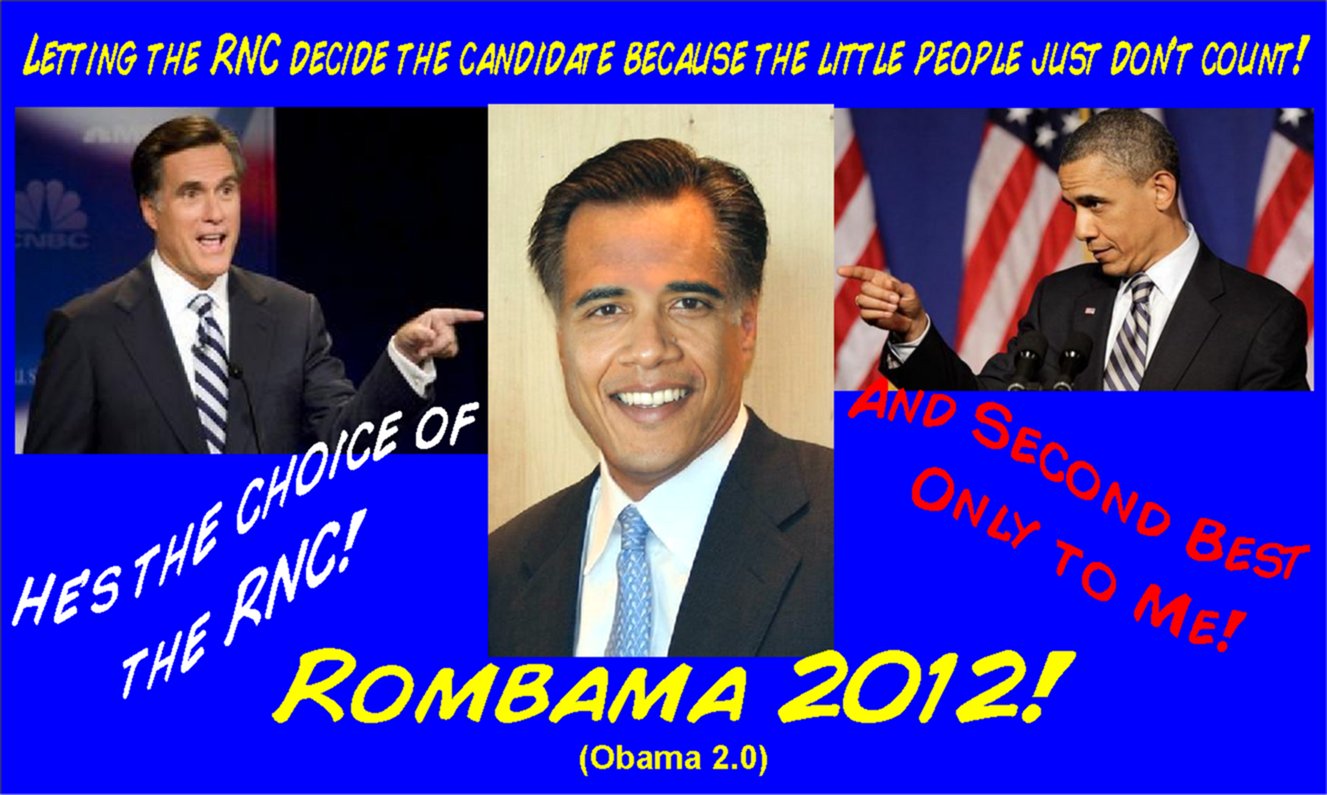
Meet Mitt Romney, Independent Candidate for President


Mitt Romney is still extremely likely to get the GOP nomination, but it looks like he will have to run in the general election as an Independent. He certainly seems to have no home in the Republican Party.
That, it seems to me, is the only discernible message coming out of Super Tuesday, which is usually a clarifying series of contests but yesterday succeeded only in muddying the outcome, even though it would require a daunting test of math for Rick Santorum (or Newt Gingrich) to find any way to garner enough delegates to beat Romney to the nomination.
Just a snapshot of the final results in Ohio tells the main story: Romney eked out a 1 percent plurality over Santorum by losing most of the traditional Republican districts but managing to take the big urban and suburban centers--Cleveland, Cincinnati, Columbus--that traditionally vote Democratic. He lost 69 of Ohio's 88 counties.
He will need those 69 counties--and more--to beat Barack Obama in November in this bellwether state, without which no Republican has ever won the presidency. Many of those Ohio Republican voters will, of course, opt for him over Obama, but it's hard to imagine them lining up enthusiastically for a man they don't see as a champion of their political beliefs and values. It says a great deal that the base's distaste for and mistrust of Romney runs so deep that a washed-up politician who was disliked even by his Republican colleagues in the Senate and a scandal-scarred former Speaker are still seen as viable alternatives, even at this late date. Even in Virginia, Romney's only opponent, a once-fringe player named Ron Paul, got 40 percent of the vote. Never mind what happened in the South and the West, where (except for Idaho) the GOP base has even less use for Romney.
In the end, Super Tuesday only supplied another heap of evidence that Romney is seen as Yesterday's Republican by the party's fast-evolving base, which is in the throes of a rebellion against Big-Government-accomodating Republicans (who include, ironically, both Santorum and Gingrich) and a country they think has evolved fatally leftward in social values. Though he  has the support of the party's "establishment" (which almost assures him the nomination), by rights Romney really should be following Sen. Olympia Snowe out the same door through which so many others of that extinct political class--centrist Republicans-- have been forced to exit, permanently exiled by a party that they no longer recognize and that no longer recognizes them. 
It's no surprise, really, that Romney so often looks and acts so uncomfortable on the campaign trail. Speaking to Republican crowds, he is like a person who has crashed a party and is only pretending to be one of the invited guests. Is it any wonder that he didn't dare talk back to Rush Limbaugh? 
So Romney's only choice if he is to win the presidency, it seems to me, is to embrace his fate: if his party no longer wants him, perhaps the large section of independent and centrist voters in the country who also feel disenfranchised by a self-marginalized Republican Party--a party that has doomed Congress to lower approval ratings than the idea of Communists taking over the U.S. government --still do. Romney needs to work hard --starting now -- at winning these voters over even as he continues to throw just enough red meat at his party base to put him over the top in delegates by the summer.
Oddly enough for a candidate whose chief vulnerability--pointed out again and again with great effectiveness by Santorum--is that he resembles the incumbent Obama too much, Romney needs to arrive at the same conclusion that Obama did: he really can do nothing to appease the main base of today's Republican Party. They don't and won't want him. So Romney's best case now is that he will make a Better Obama. 
He's certainly not going to persuade anyone that he's a better Republican.

Tuesday, March 6, 2012

The Piecemeal President: Why Obama Is No FDR--Redux


The new housing measures that Obama announced at his news conference today amount to more desultory evidence that this president has been, again and again, far behind the curve on the Depression-sized crisis caused largely by massive mortgage securitization fraud and the collapse of credit. We don't want to keep harping on this -- I've been writing it for two and a half years now--but it's important to contrast once again Obama's piecemeal approach with the FDR-sized promise we thought we were getting at the beginning. Obama is like a New Orleans official who keeps adding another layer to the old dike each day in the middle of Katrina, hoping and praying as the floodwaters slosh ominously over the top, rather than building a new dike. All that early bluster from Tim Geithner about an "economic Powell doctrine" -- using overwhelming force to combat the crisis--was complete nonsense, it turns out.


Instead we get the piecemeal president. At the beginning it was a too-small stimulus, as Noam Scheiber has recorded. Then distraction as Obama went on to other things, like health care. His administration stood against a broad array of fixes, such as the Volcker Rule that would have restored some of the spirit of Glass-Steagall  (Obama finally backed it after a year), and  broader programs for underwater homeowners (the Geithner Treasury even stood against simple language that would have made TARP money available for legal advice to foreclosed-upon homeowners, a bill sponsored by Sen. Sherrod Brown and Rep. Marcy Kaptur). He continued to take the poor advice of Larry Summers and  Geithner, two men entirely vested in remaining in a state of denial over a deep, systemic crisis whose roots stretched back to when they were deregulatory Clintonites.


And so today our un-FDR, Barack Obama, merely added another layer of sandbags to the dike. Today he announced a program to cut "by more than half" refinancing fees, and to help "members of armed forces whose home was wrongfully foreclosed on."


Very nice, but with Obama it is always too little, too late."I'm not going to stand by and wait for the housing market to hit bottom," the president said, but in effect he's been doing just that. Contrast this with FDR, whose New Deal really did amount to overwhelming force. Here is William Manchester in his magisterial "The Glory and the Dream," describing Roosevelt's first hundred days: "Before Congress adjourned in exhaustion he would have delivered ten major speeches, given birth to a new foreign policy, presided over press conferences and cabinet meetings twice a week, taken the country off the gold standard, sent fifteen messages to the Capitol, and shepherded through its chambers thirteen major pieces of legislation, including insurance for all bank deposits, refinancing of home mortgages, Wall Street reforms, authorization for nearly $4 billion in federal relief, legalization of beer, and laws creating the Civilian Conservation Corps, the Agricultural Adjustment Adminiistration, and Tennessee Valley Authority."


In December, Obama basically admitted he'd been behind the curve his whole tenure. "I think we understood that it was bad, but we didn’t know how bad it was,” Obama said. Well, how would he, if he wasn't inviting into his administration on a regular basis all the people who WERE telling him, as of Jan. 20, 2009, just how bad it was (among them, Joseph Stiglitz, Kenneth Rogoff, Paul Krugman, and Paul Volcker, who was kept at arm's length), but instead listening to Larry Summers? My goodness, Harvard's Ken Rogoff was saying well before the 2008 election just how bad things were going to get. And this was a guy who advised John McCain!


If Mitt Romney, Rick Santorum or anyone else takes the presidency away in November, they should invite Summers to the inauguration. And give him a front row seat. 

Monday, March 5, 2012

What Could Be the Difference Between War and Peace


Wednesday, February 29, 2012

The Real Reason Romney is Winning


For months now, the restless Republican search for a Not-Mitt -- a Great Red Hope -- has been described as the central dynamic of the GOP race. But I don't think that is really the story. The real reason so many Republican primary voters are holding their noses, gritting their teeth and still voting for Romney is there's simply no other qualified candidate who is running.
That is the real story.
Consider: One by one the would-be Not-Mitts have risen up, and one by one they have fallen (often helped along by intensive barrages of Romney Super PAC advertising) as it's become clear that even the GOP base, as far-right as it is, can't imagine them in the White House. Michele Bachmann was too crazed, Rick Perry too incompetent, Herman Cain too immoral (and his tax ideas too absurdly simplistic), and Newt Gingrich too hair-on-fire hypocritical and unstable. Ron Paul's role has been not unlike that of the jester in a Shakespearian play; everyone likes having him around to utter counter-conventional wisdom, but no one can imagine him replacing the king. Alone of those running against Romney, Jon Huntsman seemed clearly qualified, but he was also clearly too compromised (by his ambassador service to Obama).
The rise of the latest Not-Mitt, Rick Santorum, and what is likely now to be his inexorable decline, is following the same pattern. No one took Santorum seriously in the beginning because his run seemed self-indulgent at best. Here was a senator who was trounced by 18 points in 2006, hadn't served for six years while racking up millions as an influence peddler (sorry, "consultant") and, even when he was in the Senate, was disliked by his fellow Republicans as well as Democrats for his zealotry, incivility and inability to talk reasonably. ("That Rick is scary," one former GOP lawmaker recalls his wife saying after they left a fund-raising event together.)
Santorum did very well in the debates -- the central factor in these roller-coaster GOP polls-- as long as the focus was on Romney's flaws as a conservative. But as with Newt's penchant for rocketing off into grandiose flights of nonsense (his moon colony remark in Florida was probably the beginning of the end for him), it was only a matter of time before the Santorum that his colleagues knew and never loved --the one almost no one could imagine as president-- reappeared.
That's what happened last week. Santorum, under the apparent delusion that not only the GOP wingnuts but most of the country agreed with him, began imitating Savonarola and doing the Inquisition ("Hey Torquemada, whaddaya say?") on the campaign trail. His national and Michigan lead in the polls evaporated in a matter of hours.
I wouldn't say this if Mitch Daniels, Chris Christie, Tim Pawlenty  or even Paul Ryan were running. But the real story here is that Romney is virtually certain to get the nomination by default of being the only candidate who is even remotely qualified. The exit poll numbers in Michigan bore that out: the base liked Santorum for his moral character and conservatism, but Romney destroyed him when it came to electability.
Even so, as Romney has twisted this way and that--as well as spent much of his war chest--whack-a-moling pretender after pretender, his own electability has dropped. Which is the next real story.

What's Worse Than Too Big to Fail? Too Big to Understand


Cathy O'Neil, a New York-based data expert, has an excellent post over at Naked Capitalism describing, in ordinary person's terms, her befuddlement at paying 25 bucks to hear big-shot economists such as Paul Krugman, Jeff Sachs and Edmund Phelps speak, then realizing they still have no real idea how the financial system works. O'Neil recalled working at D.E. Shaw, the giant hedge fund, and hearing her then-colleague Larry Summers, another economist with a big brain but even bigger ego, talking about how the "liquidity fairy" would solve our financial problems. This observation brought back my own astonishment at hearing, while researching and writing my book "Capital Offense," knowledgeable people in the derivatives market whisper to me: "Summers doesn't really understand how the markets work."

Which has always been the central reason why it is necessary to break apart the too-big-to-fail structure of Wall Street. An even bigger problem than TBTF, in other words, is Too Big to Understand. WE CAN'T KEEP UP WITH WHAT THE BANKS ARE DOING, FOLKS. Even the smartest of us. The beauty of something like Glass-Steagall was that it solved that problem by ensuring that no matter how arcane trading got, the STRUCTURAL separation of risk-taking investment banks from federally insured commercial banking would do the job of protecting the system. Regulators, even in the best of times, are always going to be outpaced by the complexity and speed of markets. That's what's all but gone now, despite loophole-riddled Volcker Rule, which is limping into existence after getting torn apart by wild packs of lobbyists who resemble the wolves in the move "The Grey." And this is hardly the best of times for regulation anyway, considering the  know-nothing movement that has taken over national politics, brought back free-market primitivism, turned the history of the catastrophe of 2008 into a non-event, and permitted the rise of successive fools like Rick Santorum, Newt Gingrich, Rick Perry and so on.

As O'Neil points out, a few economists and (traders-cum-market reformers like George Soros) are now admitting what many of them were once too arrogant to confess: that economics is overwhelmed by what it doesn't know, that it cannot model or master uncertainty. The great flaw of the last decades of economic thinking, the efficient markets hypothesis era, is that there was "an implicit omniscience," as Nobelist Kenneth Arrow, who designed the best-known model of a market-clearing equilibrium, told me for Capital Offense (page 314). "It was not that economists thought there was no uncertainty, but there was a belief that you could understand the consequences of uncertainty." This is what Soros was trying to convey at that event O'Neil was at--that what's needed are theories of uncertainty itself.

Joe Stiglitz has been saying the same thing for years, begging his colleagues (and ironically developing a rep for arrogance himself) to acknowledge what they don't know, and to acknowledge that deviation from rationality is the norm, not the exception.   


As O'Neil puts it: "The problem is that the financial system has been allowed to get so complicated and so rigged in favor of the people with information, that normal people, including homeowners, credit card users, politicians, and regulators have been left in the dark."

It's going to be like the ending to one of those bad Hollywood melodramas, when the protagonist doesn't realize at first ' the monster isn't really dead. He will rise again.


Tuesday, February 28, 2012

Why Banking Is Still Not Boring Enough


Oh, there's a chill on Wall Street, all right, as we've already written. Big banks are behaving somewhat less like hedge funds with their taxpayer-insured billions, having cut back on proprietary trading. The attitude toward lending and renegotiation of terms is still the inverse of the manic bubble years, in other words reluctant at best, reflecting the time-honored values of an earlier era when the banking business was truly boring--or as one banker, Chuck Welter, put it to me for a Newsweek story in 2009, when its practitioners called it "the 3-6-3 club." In other words,  "you paid 3 percent on savings, you charged 6 percent for loans and you were on the tee at 3 o'clock."  


But we are kidding ourselves if we think Wall Street has really gone back to an era when it played its old role of serving the real economy, rather than the other way around. With the release of Noam Scheiber's new book, "The Escape Artists," we now have a substantial enough "rough draft of history" (the famous definition of good journalism proffered by Philip Graham) to establish that the structure of Wall Street, and its outsized influence on the real economy, have not really changed. In The New York Times today, the nation's most prominent book reviewer, Michiko Kakutani, places Scheiber in the lineage of chroniclers who have documented the rise of Wall Street at the expense of the rest of the economy (including yours truly, in Capital Offense: How Washington's Wise Men Turned America's Future over to Wall Street). Kakutani notes that Scheiber concludes, along with Ron Suskind, me and others, that the Obama administration could not bring itself to take on Wall Street in the end: "The banks, he says, 'won major concessions on nearly every element they’d fiercely resisted.' This not only fueled populist anger against the banks and the administration, Mr. Scheiber argues, but also left in place many of the elements (like poorly regulated derivatives and too-big-to-fail institutions) that had contributed to the 2008 cataclysm in the first place. 'As a package,' he writes, 'the reforms might mitigate whatever crisis strikes in the next 5 to 10 years. But they will not prevent it.'


This echoes what I wrote in Capital Offense more than a year ago: 
"The Clinton administration’s former deregulatory brigade, now reincarnated as Obamaites, would, in the end, decide not to tamper too much with the world they had helped create. They would accept “too many givens,” says one senior Fed official who was distressed by minimalist approach being taken to regulation. The Obama team seemed to go on the assumption that you couldn’t roll back Wall Street from what it had become, though what it had become was close to being ungovernable. The firms would remain too big to fail, and very probably too big to regulate. The big banks would buy up the failing nonbank lenders, even with all of their bad lending habits and legal liabilities. The ratings agencies would keep their old business models, exchanging their assessments for payouts from the companies they were rating—Eric Kolchinsky, the former Moody’s managing director, alleged in hearings in late 2009 that even into the year after the crisis the firm continued to deceive investors by inflating ratings on dubious securities.

"Even more significantly, no one in power in Washington dared to broach the fundamental issue: the extent to which the dominance of the financial markets within capitalist system during this freewheeling era — the fact that finance had come to hold the whip hand over labor and the manufacture and production of “real” goods and services-- had corrupted capitalism itself. Finance had once been a means to an end: the growth of the real economy. Banking had once served industry and services. Even in the robber-baron era, when J.P. Morgan and a few other lions of Wall Street controlled a lot of the real economy, they had sought to add value; they had created growth and jobs. .Now finance had become the end and the real economy was subservient to finance." 

None of this has yet changed. So let's not kid ourselves about boring banking. 

Sunday, February 26, 2012

Isn't It Time to Call Af-Pak a 'Quagmire'?' And Perhaps Obama's Vietnam?


Afghanistan has long since surpassed Vietnam as America’s longest war. And while the U.S. death toll is Afghanistan nothing like what it was in Vietnam, the news of U.S. officers getting "fragged" by their supposed Afghan allies, and in one of the most heavily guarded places in Kabul, is devastating. All of which makes me wonder whether foreign policy, in the form of the Af-Pak Quagmire--yes, it's really time to begin using the Q word--could become a big factor in the U.S. presidential election after all.

It's not just that the killing of two U.S. military officers, possibly by an Afghan intel officer, inside Afghanistan’s Interior Ministry has complicated President Obama’s plans to accelerate the withdrawal of U.S. troops and hand over operations to the new Afghan army by mid-2013.

Obama has an ever stickier problem than most people perceive. The shootings on Saturday, part of an explosion of anti-American violence ignited by the burning of Korans by U.S. troops, erupted just as the administration was quietly preparing another apology to neighboring Pakistan over the errant NATO strikes that killed 24 Pakistani soldiers last fall.

The Koran incident prompted an apology delivered by Gen. John Allen, commander of U.S. forces in Afghanistan. The Pakistan  apology was to have been delivered shortly by high-ranking U.S. military and civilian officials, most likely by Joint Chiefs Chairman Martin Dempsey and Secretary of State Hillary Clinton, two U.S. officials told me in a story for National Journal. The statement of contrition, linked to an official Pentagon investigation that partially blamed mistakes made by U.S. forces for the NATO incident, as put off indefinitely after the Koran incident, but U.S. officials say they still plan to deliver it in coming weeks. 

The apologies over the Koran incident and the NATO strikes pose some political peril for Obama at home in an election year. Republican presidential candidates have been regularly accusing Obama of appeasement and, as former Massachusetts Gov. Mitt Romney has put it, “apologizing for America.”

But Obama has little choice. In some ways the safe haven problem of Pakistan makes Afghanistan a tougher problem than even Vietnam. Last month, Ryan Crocker, the U.S. ambassador to Afghanistan, sent a top-secret cable to Washington concluding that Taliban havens in Pakistan were jeopardizing the success of the U.S. strategy in Afghanistan, The Washington Post reported on Saturday. That echoed many other analyses, including this one by retired Marine Col. T.X. Hammes, a counterinsurgency expert, who told me nearly a year ago that the Pakistan problem was far worse than the challenge U.S. forces had faced in dealing with the insurgency in Iraq, which had benefited from open borders with Syria and Saudi Arabia.

The administration initially had refused to apologize for the NATO strikes. The White House, Pentagon and State Department rebuffed the U.S. ambassador to Pakistan, Cameron Munter, early on when he pressed for an immediate apology following the Nov. 27 incident. But prodded by the new Pakistani ambassador in Washington, Sherry Rehman, the State Department resurrected the idea in recent weeks, and this time the White House and Pentagon signed off on it. 

As one Defense official put it this week, the administration realized that something had to be done to “try move past the rough patch” with Pakistan, with U.S.-Pakistan relations still roiled by the fatal NATO strikes and other disputes, especially the unilateral mission that killed Osama bin Laden in a Pakistani city last year.  The administration must give Islamabad a face-saving way to resume normal ties. The United States is pushing for talks with the Taliban ahead of a planned withdrawal from neighboring Afghanistan that is to be completed in 2014. Recently the Afghan government and Pakistani Prime Minister Yusuf Raza Gilani also called for negotiations with the Taliban.

U.S. officials fear that without more assistance from Islamabad, the Taliban could exploit the American withdrawal from Afghanistan to wreak havoc from across the border. Relations between Pakistan and Afghanistan are also tense following the assassination of Burhanuddin Rabbani, Afghan President Hamid Karzai’s chief peace negotiator and a former Afghan president himself, last September, allegedly by a Taliban suicide bomber. Kabul blamed Pakistan for the attack. Pakistan denied it, but Islamabad has sought to support the Islamist group as a strategic asset. 

Yep, it's a quagmire all right.


Friday, February 24, 2012

Syria: No Different from Bosnia, Kosovo or Libya


We’ve seen this horror movie before. Distracted by other things, the West begins by ignoring a distant humanitarian disaster, then denies it, minimizes it and explains it away. But as images of murdered women and children are transmitted onto newspaper front pages and nightly broadcasts and (now) the internet, the pressure to act grows unbearable, no matter the cost.
We are likely to watch the same script play out very quickly in Syria, where the regime of Bashar al Assad has been brutally suppressing an insurrection for months. U.S. and Europeans officials are, for the most part, still in the same stage of denial,  minimization and explaining-it-away that they were in a few months ago. While people are dying by the thousands, the Western nations are still arguing that that military intervention in Syria is not practical, and that it is legally impossible without a U.N. Security Council resolution that the Russians and Chinese are blocking.
The United States, France and Britain are laying most of the blame for their inaction on Moscow, Assad’s strongest ally. French Foreign Minister Alain Juppe , meeting recently with his Russian counterpart, Sergei Lavrov, sought to deliver a sense of urgency about the killings and suggested that Russia was jeopardizing its relations with the rest of the Arab world and putting the legitimacy of the U.N. at risk. One senior Western official grew notably defensive on Thursday, contrasting what the West and Arab League have done so far (including calls for Assad to step down, backed by a 70-nation “Friends of Syria” meeting in Tunis on Friday) with the international silence that greeted Bashar al Assad’s father, Hafez, when in 1982 he crushed a rebellion by killing perhaps 20,000 people in the town of Hama. “Look how different the response has been,” he said. “The deeper the regime goes into repression, the closer it brings the country to the end of the story,” he said.  “Because this story will have an end.”
But in truth, the end is nowhere in sight; as Joshua Landis, a highly respected Syria expert, writes in the forthcoming Middle East Policy journal, the Assad regime is entrenched and can likely endure through this year. And how many more will die on video before the end comes? The self-approbation we’re hearing from the West is disingenuous at best. Hama occurred without tweets, or cell phone videos , or internet. Today, by contrast, the pressure to intervene will escalate quickly in proportion to the terrible images coming out of Syria. The death this week of a highly respected American war correspondent, Marie Colvin of the Sunday Times of London, who filed a moving final dispatch before being killed by a Syrian rocket, only punctuated the inadequacy of the Western response so far. It is a response that is all the more embarrassing in contrast to the regime-change success that  the U.S., France and Britain were proudly pointing to in Libya only a few months ago.
True, Syria is a particularly hard problem, a country riven by a complex network of tribal and ethnic divisions. The regime seems to have more support than Muammer al-Qaddafi’s did in Libya a year ago, both inside and outside the country, and the rise of Islamist factions is a real threat. Western officials are now pointing to the broad coalition being formed, even with Russia and China preventing action on the Security Council.  “We’re talking 70-plus countries on the heels of a UN General Assembly vote that was overwhelmingly in support of the Syrian people, the Syrian opposition, so we believe there’s strong international pressure on Assad,” State Department spokesman Mark Toner said. 
On Friday, a draft of an ultimatum issued to Assad was circulated, calling on "the Syrian government to implement an immediate cease-fire and to allow free and unimpeded access by the United Nations and humanitarian agencies to carry out a full assessment of needs in Homs and other areas."
But without an imminent military threat confronting him, such words are unlikely to move Assad very much. The Syrian dictator has cast his lot; like Shakespeare’s Macbeth, he has already waded so deeply into bloodshed that it is too late for him to turn back.
More active solutions are being hinted at, especially covertly arming the Syrian opposition through Arab countries, which is already occurring. “It’s not something we’re not encouraging,” a senior U.S. official told National Journal this week. Anne-Marie Slaughter, Secretary of State Hillary Clinton’s former policy planning chief, also proposed more active support for the loosely organized Free Syrian Army allowing it to set up “no kill zones.”  Even Slaughter appeared to be criticizing her former superiors for their laggard response. “The mantra of those opposed to intervention is ‘Syria is not Libya,’” she wrote. “In fact, Syria is far more strategically located than Libya, and a lengthy civil war there would be much more dangerous to our interests.”
It’s highly unlikely that the gradual arming of the Syrian opposition will be enough. U.S. presidents have a way of getting dragged into situations they never wanted to address, convinced that it is not directly related to U.S. national interests. Obama has already experienced this in Egypt, Libya and Yemen. Something similar happened to Bill Clinton in Mogadishu, Bosnia, and finally in East Timor, a faraway island that lay at the furthest reaches of the faraway nation of Indonesia—in other words, about as distant as you can get from what was once considered America’s national interest. In 1999, Indonesian-backed militias who didn't want the East Timorese people to declare independence were hacking separatists to death with machetes. People were dying by the thousands, just as they are now, in the full glare of the international media. But initially Clinton’s national security advisor, Sandy Berger, flippantly told reporters that he didn't "intervene" every time his daughter messed up her room at college.
Then a strange thing happened. Clinton found that, no matter how hard he tried, he could not get away from the East Timor crisis. It kept popping up in front of him, like some maddening ghost image, no matter which way he turned. There it was in TV and newspaper headlines, in reporters’ persistent questions, and at the top of his discussions with other heads of state at an annual summit of Pacific rim nations. Ultimately a U.N. Security Council resolution authorized Australian-led special operations forces to go in and stop the killing.
Something like that will have to happen now, once the West stops minimizing the crisis; even if the U.N. Security Council remains paralyzed, the newly empowered Arab League can provide a cover of legitimacy. All that remains to be done is to summon up the will to act.